Fish Sludge - from Waste to Feed?
Nina Liland, Researcher IMR (Institue of Marine Research)
FTA Issue No.3 2025
Can fish sludge become a promising resource for sustainable feed?
Fish sludge is rich in valuable elements like phosphorus, nitrogen, and marine fatty acids. Studies show that while sludge composition varies widely, it can support the growth of invertebrates such as black soldier fly larvae, potentially closing nutrient loops in the food chain.
However, the transformation isn’t without hurdles. This paper by researcher Nina S. Liland highlights major challenges. Ensuring feed and food safety, optimizing sludge processing, and adapting legislation are crucial steps on the path to a circular bioeconomy.
This article can be downloaded as a PDF at the Fjell Tech agenda homepage - Download center.
Fish sludge, the uneaten feed and feces from farming of fish, is currently the subject of many discussions regarding its possible uses. We know that sludge from farming of Atlantic salmon contains phosphorus, nitrogen as well as other valuable nutrients like marine fatty acids, amino acids and zinc. By collecting fish sludge from aquaculture operations, we are avoiding that these nutrients end up in the environment, where they can cause eutrophication (Grefsrud et al. 2025).
Recycling nutrients more efficiently and avoiding losses to the environment is a step in the direction of a sustainable and circular food production. It is estimated that the Norwegian salmon farming industry loses more than 9000 tons of phosphorus into the coastal waters each year as uneaten feed and feces (Aas et al. 2017).
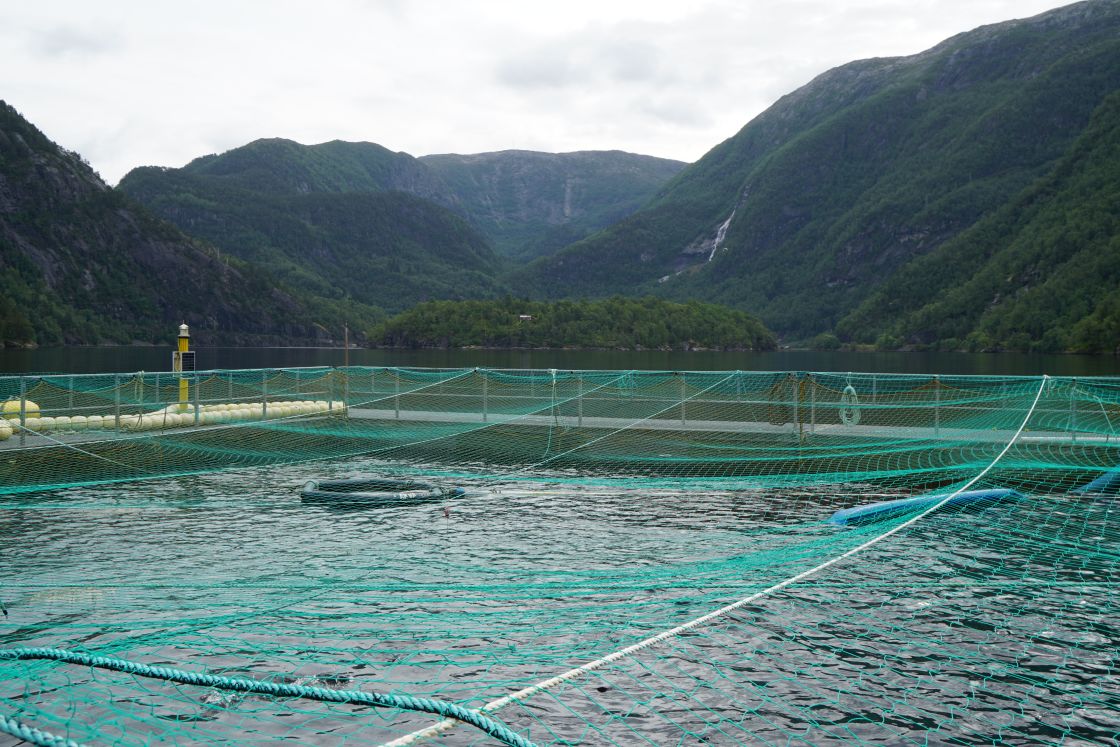
Image 1: Picture from Matre Research Station in Masfjorden. The research station plays a key role for the Institute of Marine Research’s activities in aquaculture research and fish experiments. Photo credit: Pauline Paolantonacci / Havforskningsinstituttet.
In Norway, fish sludge is currently only being collected in land-based facilities due to regulations on water quality released from these production plants. For ongrowing production plants in the fjords, there are only a few facilities that currently collect sludge. This is largely due to collection systems being laborious and technically challenging in commercial practices. Additionally, clear pull incentives to collect sludge in the seawater based ongrowing plants have been absent. However, in October 2025 a new Environmental flexibility regulation was announced that gives clear incentives for fish farmers to produce salmon and trout in enclosed cages, including the collection of sludge from these production plants.
A better understanding of this new waste stream and its inherent challenges and opportunities, including possible downstream uses, is important to assess how fish sludge can be a piece of the circular bioeconomy puzzle and to discuss options to incentivize more of its collection.
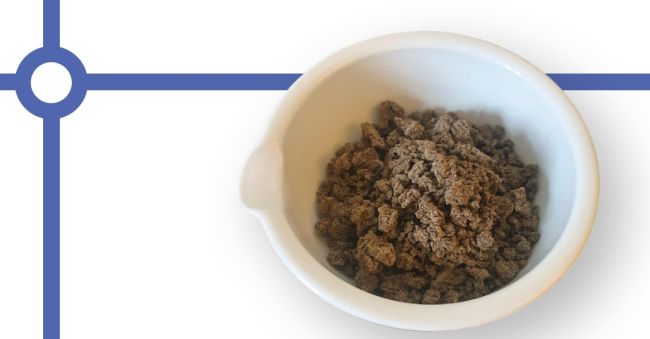
Dried fish sludge. Photo credit: Havforskningsinstituttet.
High variability in composition of sludge
There are ongoing research and innovations in many fields on how to best use fish sludge, with proposed solutions ranging from using it into biogas productions, applying it in agriculture as a fertilizer, using it as feed to insects and other invertebrates, converting it to energy, or upcycling the nutrients in sludge into feed ingredients. One of the challenges concerning potential uses of the sludge is the variability in its composition. In a recent study we analysed the composition of close to 50 samples of sludge from Norwegian smolt-producers (Sele et al. 2024). We found that some of the sludge samples had high content of feed spill, and thus having a composition close to a commercial fish feed (high in protein and fat). Other batches of sludge contained very little feed spill and had a composition more like fish feces.
To exemplify the large range in composition, the sludge samples highest in fat had almost 30% fat, while the samples lowest in fat were at only 0.5% fat. But regardless of total energy content, all samples were significant sources of nutrients, especially the ones less digestible by the fish, such as phosphorus. This means that even if you would avoid much of the feed spill in a production, collected sludge would still be a significant source of nutrients that could be cycled back into the food production.
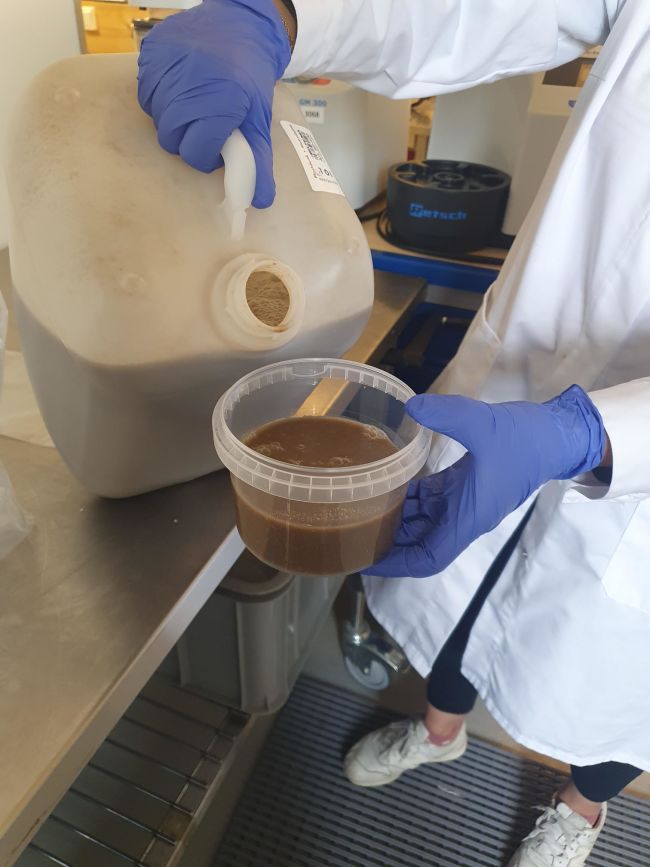
Analysis of wet sludge samples.
In terms of undesirable substances, 43% and 84% of the sludge samples contained levels of arsenic and cadmium, respectively, exceeding the EU Maximum Levels established for complete animal feeds. The same contaminants, in addition to zinc, would limit the use as a fertilizer in agriculture. We also analysed several organic pollutants, including dioxins, PCB and PFAS, compounds that are regulated in feed and/or food. None of these exceeded the current legislative limits for animal feed. In addition, selected samples were screened for emerging contaminants. These are contaminants not yet regulated or normally surveyed for in food and environment. For example, plastic related chemicals were among the 18 emerging contaminants detected. Such contaminants requires more attention.
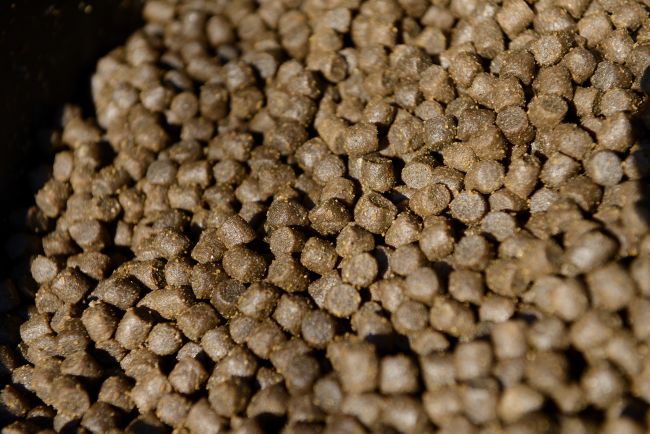
Image of fish feed. There is high variability in composition of sludge. Some contain such a high content of feed spill that its composition is close to a commercial fish feed. Photo credit: Helge Skodvin / Havforskningsinstituttet
Some of the variations in sludge composition can be explained by feed spill content, while others can be due to other factors, ranging from feed composition, type of fish farm and wastewater sources, fish digestion as well as likely being highly influenced by the process of collecting, thickening, dewatering and drying of the sludge. Further investigations and studies are needed to understand better how these factors affect sludge composition.
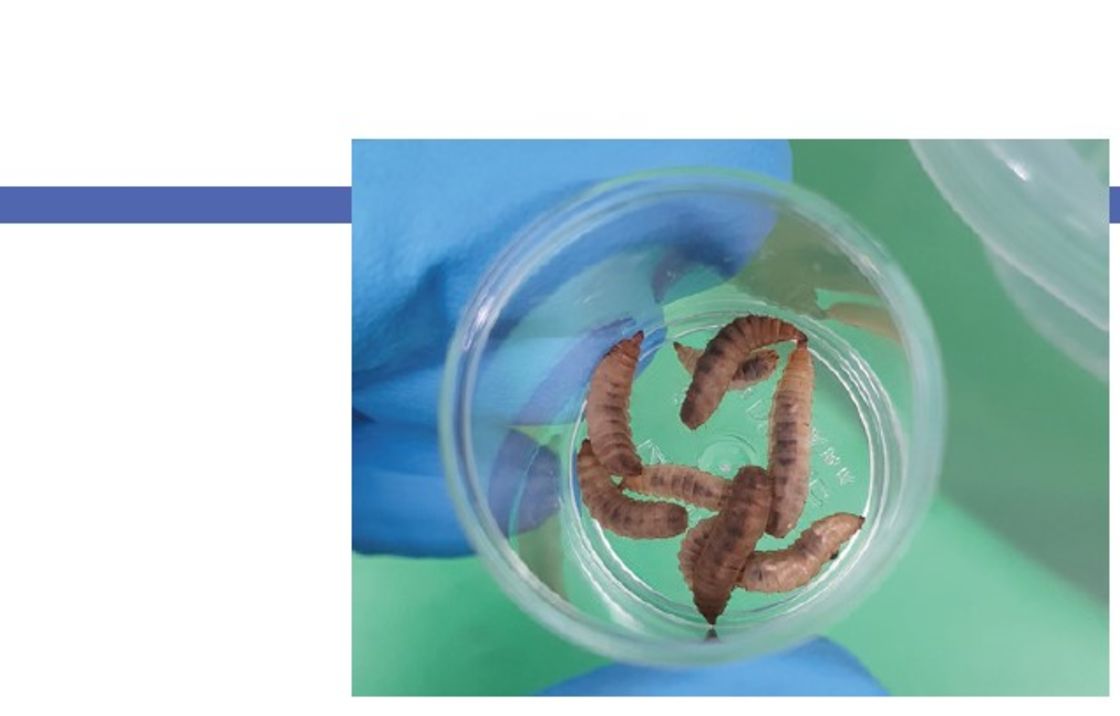
Insect larvae used in our studies; these can grow on pure fish sludge from salmon smolt production. Photo credit: Havforskningsinstituttet
Upcycling fish sludge to feed ingredients
The practical use of fish sludge after collection is inhibited by several barriers related to legislation; for example, sludge is not allowed for insect growth due to strict EU regulations related to feed and food safety and categorizations of waste streams. We have, however, shown that it is possible to grow black soldier fly larvae, the most produced insect larvae for feed purposes, on pure fish sludge from salmon smolt Production (Schmitt et al. 2019; Liland et al. 2023; Belghit et al. 2024). From the sludge, the insects accumulate essential lipids and trace elements, showing the potential of transferring these valuable nutrients into a high-value protein and lipid source.
The European insect industry is actively looking for relevant feed substrates for their production, and as such, fish sludge could be a potential alternative and locally sourced feed, if allowed as an insect feed. The sludge is, however, not an optimal food for the insect larvae alone, since they would also need carbohydrates for optimal growth. More research is needed to support optimisation of fish sludge as a growth-promoting feed for insect larvae.
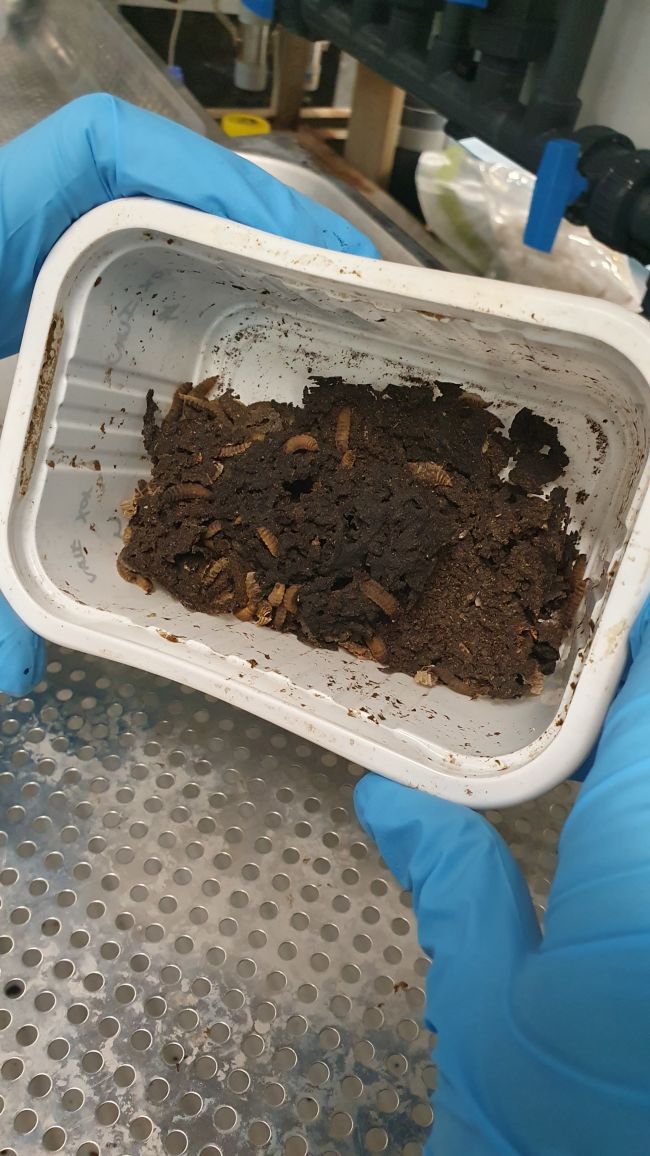
Insects growing in fish sludge.
Feed safery concerns
When recycling the nutrients in sludge back into the food chain, such as via insect larvae, there are several aspects related to food and feed safety that are important (Pettersen et al. 2025). Firstly, the variable contents of chemical contaminants in the sludge needs to be accounted for, but also the risk of transferring contaminants to the final product. Our studies show that if you use a substrate consisting of only fish sludge, insects will be in risk of containing levels of contaminants like cadmium, arsenic and dioxins reaching and potentially exceeding the maximum levels set in the EU regulation for feed ingredients (Belghit et al. 2024; Liland et al. 2023).
However, the contaminant load and profile will depend on the content of contaminants in the starting product, the fish sludge. Nonetheless, this is something that would need to be handled by having close control of the feed given to the insects. Different ways of upcycling sludge will also bring their own specific feed safety challenges. With this we mean that the black soldier fly larvae will take up and store contaminants differently than other organisms proposed to upcycle sludge, such as polychaetes (Malzhan et al. 2024).
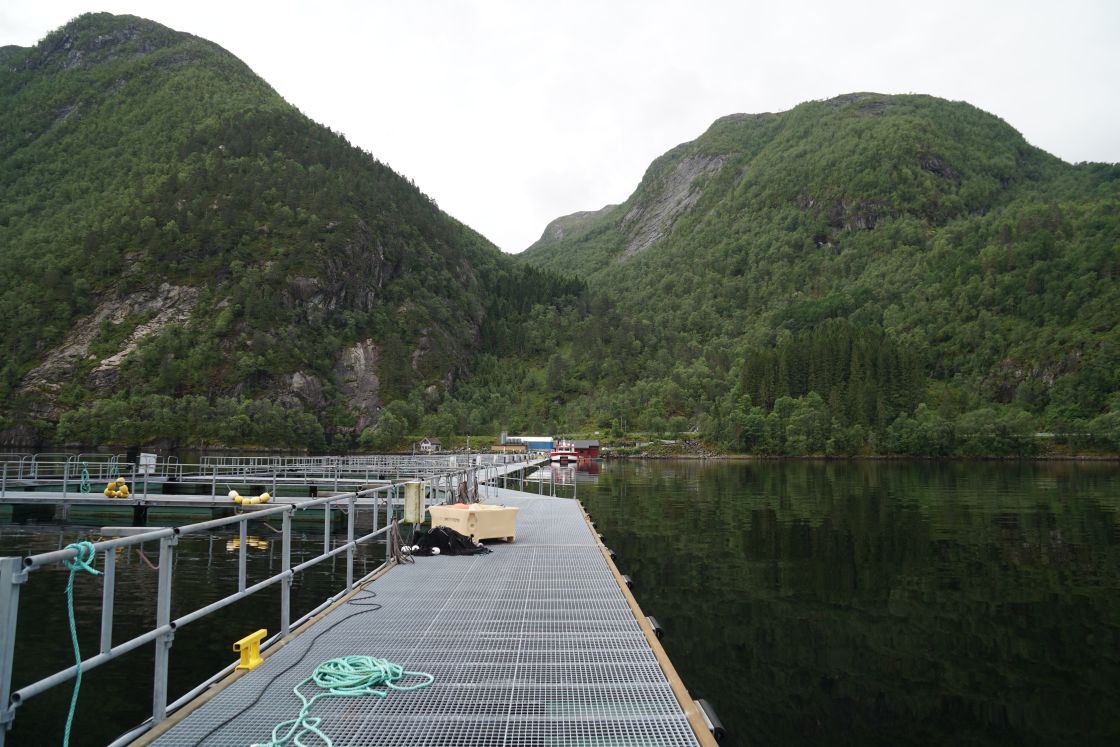
Picture from Matre Research Station in Masfjorden. The facility was established in Masfjorden in 1971 and has been instrumental in the development of modern aquaculture. The research station has three hatcheries and two fish farms located in the fjord consisting of a mix of sea cages of various sizes. Photo credit: Pauline Paolantonacci / Havforskningsinstituttet.
Secondly, a transfer of pathogens from the sludge to the potential ingredients is also seen as a risk. In our studies we find that there is little risk of transferring typical salmon pathogens from the sludge to the insects, due to the higher temperature that the insects need to thrive (30 ⁰C). This is far above levels where an Atlantic salmon pathogen would survive for long (Belghit et al. 2024). However, more knowledge is needed also in this field, including how to process or sanitise the sludge to provide a safe substrate for further use.
To conclude, utilising sludge optimally as a resource in a circular bioeconomy requires more knowledge on:
- how different factors affect the composition of sludge
- how various recycling methods affects the feed and food safety..

Potential in a circular bioeconomy
With the current knowledge we have on fish sludge, it is evident that we need more documentation on the composition of the sludge and its’ variations. We need to understand the potential risks of including it in a circular process, but also its nutritional content. Insight on risks and nutritional content is essential when identifying where fish sludge is best used.
Moreover, it is critical input to the possible adaptations in legislation that can enable safe use of this resource into a nutrient recycling process. Current research on the topic focuses on all aspects of the value chain, ranging from collection of sludge, transport and logistics, food and feed safety as well as assessing environmental footprints of the different uses of sludge. Ultimately, the goal is to enable fish sludge to be an integral part of a circular bioeconomy, producing safe end products and promoting efficient nutrient upcycling.
References
Aas, T. S. and T. Åsgård (2017). Estimert innhold av næringsstoff og energi i fôrspill og faeces fra norsk lakseoppdrett. Rapport 18/2017. ISBN: 978-82-8296-516-3.
Belghit, I., N. S. Liland, A. K. Lundebye, J. Tibon, H. Sindre, H. Nilsen, A. Hagemann and V. Sele (2024). ”Aquaculture sludge as feed for black soldier fly: Transfer of chemical and biological contaminants and nutrients.” Waste management 187: 39-49.
Liland, N. S., M. Sørensen, I. Belghit, F. P. Willora, A. Torrissen and O. Torrissen (2023). ”Closing the gap – producing black soldier fly larvae on aquaculture side streams.” Journal of Insects as Food and Feed 9(7): 885-892.
Malzahn, A. M., V. Sele, I. Belghit, J. Tibon, H. Nilsen, H. Sindre, N. S. Liland and A. Hagemann (2024). ”Transfer and bioaccumulation of chemical and biological contaminants in the marine polychaete Hediste diversicolor (OF müller 1776) when reared on salmon aquaculture sludge.” Journal of Environmental Management 367: 122073.
Pettersen, K. S., V. Sele, P. Araujo, I. Belghit, S. L. Benestad, A. Bernhoft, A. M. Booth, G. S. Eriksen, J. Farkas, A. H. Handå, B. H. Hansen, K. O. Helgesen, A. Holst-Jensen, G. S. Johannessen, N. S. Liland, A.-K. Lundebye, A. M. Malzahn, H. Nilsen, T. S. Nordtvedt, M. Norström, M. M. Owczarek-Kościelniak, Ø. Øines, S. J. Patel, H. Sindre, I. B. Standal and A. Hagemann (2025). ”Fish Sludge as Feed in Circular Bioproduction: Overview of Biological and Chemical Hazards in Fish Sludge and Their Potential Fate via Ingestion by Invertebrates.” Reviews in Aquaculture 17(1): e12996.
Schmitt, E., I. Belghit, J. Johansen, R. Leushuis, E.-J. Lock, D. Melsen, R. Kathirampatti Ramasamy Shanmugam, J. Van Loon and A. Paul (2019). ”Growth and Safety Assessment of Feed Streams for Black Soldier Fly Larvae: A Case Study with Aquaculture Sludge.” Animals (9): paper 189.
Sele, V., A. Ali, N. Liland, A.-K. Lundebye, J. Tibon, P. Araujo, H. Sindre, H. Nilsen, A. Hagemann and I. Belghit (2024). ”Characterization of nutrients and contaminants in fish sludge from Atlantic salmon (Salmo salar L.) production sites - A future resource.” Journal of Environmental Management 360: 21103.
Fjell Tech Agenda is a publication by Fjell Technology Group aimed at sharing knowledge with customers, partners, and stakeholders. Its purpose is to present complex topics in a clear and accessible format for non-experts. The publication is not intended to promote Fjell Technology Group’s products or services. All content reflects the views and insights of the individual author, and Fjell Technology Group does not assume responsibility for the opinions expressed.
Suggestions for future topics are welcome at post@fjelltg.com.
Happy reading!

Nina S. Liland, Research Group Leader, IMR
Nina S. Liland has a background in fish nutrition and has been working on circular practices such as use of insects as an aquafeed ingredient and upcycling of different organic streams, like sludge or macroalgae, into feed.